Monday, February 20, 2006
Building a Source Code Generator II
Last article described the basic infrastructure of writing a source code generator. The design is now implemented in Codejen Framework and available in SourceForge.net.

Friday, February 03, 2006
Building a Source Code Generator I
Recall the following components to build a source code generator:
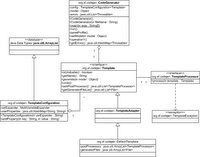 The diagram on the left included the classes designed for #4 to #7.
Example configuration XML:
Also, if you are familiar with ANT, you can use ${propKey} style to access the property value.
- A model that describe your application - you don't need to define it yourself, you can use XMI or XML schema as the reference model. The only problem is how you parse them to the object model.
- A template engine - Velocity or Freemaker are good template engines in Java.
- Templates that corresponding to the model - Generate code Java, PHP, C#, etc.
- A configuration of templates - There would be configurations for desktop app, web app, RIA, or web services, etc.
- A parser that parse the configuration - If the configuration is an XML file, Apache's commons-digester library can help.
- A driver to glue up everthing.
- Optionally, a validator for the template is good - JavaCC or ANTRL for syntax validation. For the extreme, use a compiler to verify the correctness of the generated code.
 The diagram on the left included the classes designed for #4 to #7.
- CodeGenerator - the parser of the configuration file and the driver gluing up everything.
- TemplateConfiguration - an list of template that can stores the properties specified in the XML file.
- Template - a class representing the state of a template.
- TemplateProcessor - processor that may perform validation or beautification of the generated code.
Example configuration XML:
<profile>The required attributes are
<property key="asdf" value="1" />
<property key="templateDir" value="x ${asdf}" />
<template class="org.sf.codejen.test.TestTemplate" a="${templateDir}">
<postProcessorFactory class="org.sf.codejen.test.TestProcessorFactory" b="jkl;" />
</template>
</profile>
- profile/property - key and value
- profile/template - class
- profile/template/postProcessorFactory - class
Also, if you are familiar with ANT, you can use ${propKey} style to access the property value.
Sunday, January 29, 2006
How to build a source code generator
- A model that describe your application - you don't need to define it yourself, you can use XMI or XML schema as the reference model. The only problem is how you parse them to the object model.
- A template engine - Velocity or Freemaker are good template engines in Java.
- Templates that corresponding to the model - Generate code Java, PHP, C#, etc.
- A configuration of templates - There would be configurations for desktop app, web app, RIA, or web services, etc.
- A parser that parse the configuration - If the configuration is an XML file, Apache's commons-digester library can help.
- A driver to glue up everthing.
- Optionally, a validator for the template is good - JavaCC or ANTRL for syntax validation. For the extreme, use a compiler to verify the correctness of the generated code.
Tuesday, January 24, 2006
Web 2.0 is Just a Milestone
After reading some articles and blogs, I found that Web 2.0 is not really new thing. It's just a milestone that saying the internet has evolved into new phases. People are not working alone but collaborated. XML and HTTP make different platforms more integrated comparing to the DCOM and COBRA. Thanks to AJAX, web applications are almost as dynamic as desktop applications. Whenever you go, whereever your are. You can access the application with your electronic devices (mobile phone, PC, PDA, etc). No more deployment and update patches is need.
If Web 2.0 is a milestone, what else we can do with it? Just celerbrate and get back to work! Have we rearched the milestone yet? Not really! Let's work harder for it.
If Web 2.0 is a milestone, what else we can do with it? Just celerbrate and get back to work! Have we rearched the milestone yet? Not really! Let's work harder for it.
Friday, October 21, 2005
The Future of Programming
I share the same vision about programming with Microsoft. DSM will rule and MDA cannot dominate the market. So, does it imply programming will no longer exist if we define enough DSL? The answer is no.
There aren't "enough" DSL in the future. At least, there will be two camps of DSM tools, Microsoft (Software Factories) and Eclipse (EMF+VEF). For MS, sure it will be only .NET platform. For Eclipse, however, it will be for the whole all platforms. For different languages, UI, and DBMS. There are infinite combinations for us to define.
The future of programming is programming the DSL for user to define it's own application on the system specifications.
There aren't "enough" DSL in the future. At least, there will be two camps of DSM tools, Microsoft (Software Factories) and Eclipse (EMF+VEF). For MS, sure it will be only .NET platform. For Eclipse, however, it will be for the whole all platforms. For different languages, UI, and DBMS. There are infinite combinations for us to define.
The future of programming is programming the DSL for user to define it's own application on the system specifications.
Tuesday, May 24, 2005
JavaScript Obfuscator
I have recently written an obfuscator for JavaScript in Java. It is available at:
http://www.shaneng.net/
It exploit some feature of JavaScript so that I don't need to understand the content of JavaScript. To start, the obfuscator just "blindly" replace the variables without leading dot (e.g. window.parent has the dot). Then, I managed to remove the comments. Later, it also encode character in the string literals into \uXXXX or \XXX format.
In the current version, I refactor it so that it is more managable. In the future, I would like to handle the source code with E4X syntax.
http://www.shaneng.net/
It exploit some feature of JavaScript so that I don't need to understand the content of JavaScript. To start, the obfuscator just "blindly" replace the variables without leading dot (e.g. window.parent has the dot). Then, I managed to remove the comments. Later, it also encode character in the string literals into \uXXXX or \XXX format.
In the current version, I refactor it so that it is more managable. In the future, I would like to handle the source code with E4X syntax.
Tuesday, April 19, 2005
JavaScript: setInterval() problem
Have you been trying to write some class like this:
To solve the problem, the code be written like this:
Update (2009-03-29)
Thanks to the comment by dedogs, we could actually write the code like this without the cyclic reference:
function y() {
  this.x = 0;
  this.start = function () {
      this.interval = setInterval(this.run, 1000);
  };

  this.run = function () {
      this.x++;
      debug(this.x); // or some other things you want to do
  };

  this.stop = function () {
      clearInterval(this.interval);
  };
}
You may attempt to refer the x in the run() function. However, in JavaScript, the scope of the function becomes the window after running setInterval() (or setTimeout()).To solve the problem, the code be written like this:
function y() {
   this.x = 0;
   var self;

   this.start = function () {
       self = this;
       this.interval = setInterval(run, 1000);
   };

   function run() {
       self.x++;
       debug(self.x);
   }

   this.stop = function () {
       clearInterval(this.interval);
       self = undefined;
   };
}
Since using the self variable will create a cyclic reference, it should be cleaned up properly. Otherwise, the garbage collector of the script interpreter(s) which use(s) reference count will not be able to collect the instance.Update (2009-03-29)
Thanks to the comment by dedogs, we could actually write the code like this without the cyclic reference:
function y() {
  this.x = 0;
  this.start = function () {
      var self = this;
      this.interval = setInterval(function(){ self.run(); }, 1000);
  };

  this.run = function () {
      this.x++;
      debug(this.x); // or some other things you want to do
  };

  this.stop = function () {
      clearInterval(this.interval);
  };
}
Saturday, April 16, 2005
AJAX: XMLHTTPRequest Event Handling
Most of the XMLHTTPRequest uses the following implementation:
The resolve this problem you can try to write the code in this way:
function run1() {
  xmlhttp = new XMLHTTPRequest();
  xmlhttp.onreadystatechange = processStateChange;
  ...
}

function processStateChange() {
  if (xmlhttp.readyState == 4) ...
}
The problem is, when you have many events to handle, the variable xmlhttp in run1 may have assigned to different instances by different functions (e.g. run2, run3, etc). If you rely on this code, no one can gaurentee that your code will run correctly.The resolve this problem you can try to write the code in this way:
function run1() {
  var xmlhttp = new XMLHTTPRequest();
  xmlhttp.onreadystatechange = function() { ... }
}
If you insist to write the handle in a function, here is another style of writing it:function run1() {
var xmlhttp = new XMLHTTPRequest();
xmlhttp.onreadystatechange = function() {
processStateChange(xmlhttp);
}
...
}
function processStateChange(xmlhttp) { ... }
Subscribe to:
Posts (Atom)